
Executive Summary
Among motorcyclists, Sardinia enjoys a near-mythical reputation. Riders travel from across Europe to experience its sweeping mountain roads, exceptional pavement, dramatic coastline, and relatively light traffic. Yet available crash statistics indicate that Sardinia experiences one of the highest roadway mortality rates in Italy, with motorcyclists representing a significant portion of roadway deaths. During several days of riding throughout Sardinia, the author had the opportunity to experience the island’s roadway infrastructure firsthand.
This paper examines that apparent paradox: an island celebrated among riders for its safety and quality of infrastructure that also carries one of Italy’s highest roadway mortality rates. The discussion draws on ISTAT and ACI–ISTAT crash data, motorcycle-specific fatality figures, and the risk-compensation literature to argue that Sardinia’s crash environment is distinguished less by how often crashes occur than by how severe they are when they do.
The Riding Environment
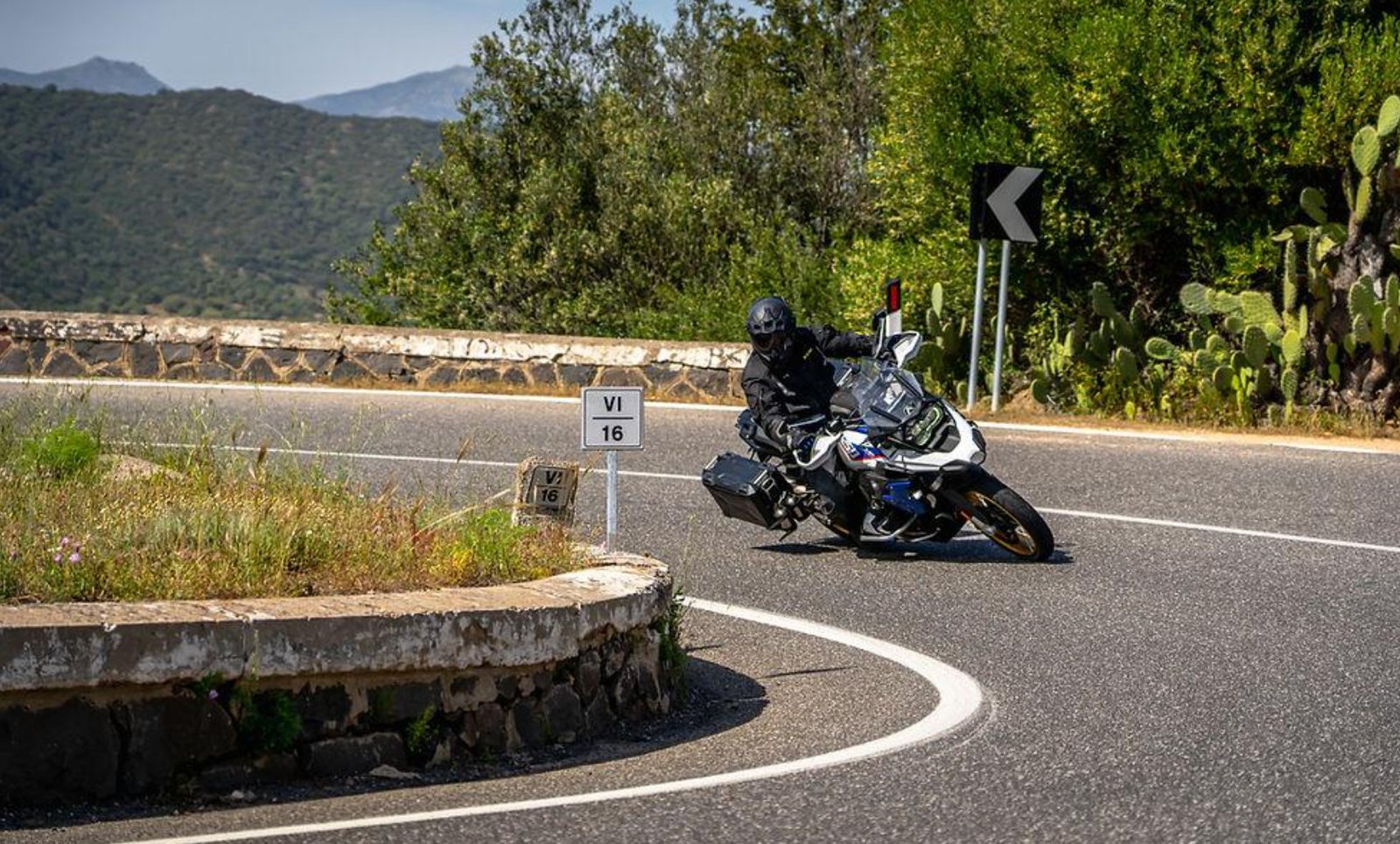
Most discussions about motorcycle safety focus on obvious hazards such as congestion, distracted drivers, poor pavement, adverse weather, and limited visibility. Sardinia appears to have relatively little of these problems. Riders instead encounter smooth pavement, excellent sight distances, relatively low traffic volumes, and the seemingly never-ending sequences of curves that make motorcycling uniquely rewarding.
Road Safety in Sardinia
According to ISTAT data, Sardinia recorded 3,313 injury crashes, 100 roadway fatalities, and 4,557 injured persons in 2022. More recent reporting identified 113 roadway fatalities in 2024. Several highways repeatedly appear in fatal-crash discussions, including the SS125, SS131, SS389, and SS129.
| Year | Injury Crashes | Roadway Fatalities | Persons Injured |
| 2022 | 3,313 | 100 | 4,557 |
| 2024 | — | 113 | — |
Sardinia roadway crash and fatality data. Source: ISTAT, ACI–ISTAT regional reporting.
Sardinia Compared with Mainland Italy
ACI–ISTAT publishes two related but distinct statistics that are both loosely translated as “mortality,” and the two should not be conflated. The tasso di mortalità (road-mortality rate) measures deaths per 100,000 residents — a population-exposure statistic. The indice di mortalità (mortality index) measures deaths per 100 crashes — a crash-severity statistic. Sardinia ranks among the worst in Italy on both measures, but the two describe different things and carry different figures.
On a population basis, Sardinia recorded a road-mortality rate of 7.0 deaths per 100,000 residents in 2023, the highest of any Italian region, against a national average of 5.2. On a crash-severity basis, Sardinia’s mortality index was 3.0 deaths per 100 crashes in 2022 and 3.2 in 2023, compared with a national average of approximately 1.9 in 2022.
| Metric | Sardinia | Italy (National Average) |
| Road-Mortality Rate (deaths / 100,000 residents, 2023) | 7.0 | 5.2 |
| Mortality Index (deaths / 100 crashes, 2022) | 3.0 | 1.9 |
Road-mortality rate and crash-severity mortality index, Sardinia vs. national average. Source: ISTAT, ACI–ISTAT.
The crash-severity gap is large enough to test directly against the underlying 2022 crash counts: 100 deaths among 3,313 injury crashes in Sardinia, versus 3,159 deaths among 165,889 injury crashes nationally. A two-proportion z-test on these figures returns z ≈ 4.6 (p < 0.0001), indicating the gap is not attributable to the smaller size of Sardinia’s crash sample. From a safety perspective, this supports the conclusion that the distinguishing characteristic of Sardinia’s crash environment is not necessarily crash occurrence, but crash outcome: crashes occurring on the island are statistically more likely to produce fatal consequences than crashes elsewhere in Italy.
Motorcycle Fatalities and Exposure
Reported figures include 25 motorcycle fatalities in 2022, 29 in 2023, and 22 during the first half of 2024. Sardinia attracts substantial motorcycle tourism from Germany, Austria, Switzerland, France, and mainland Italy, making exposure an important consideration when interpreting these figures.
| Year | Motorcycle Fatalities |
| 2022 | 25 |
| 2023 | 29 |
| 2024 (H1) | 22 |
Motorcycle fatalities in Sardinia by year. Source: ACI–ISTAT, regional reporting.
What Motorcycle Safety Research Shows
Motorcycle crash-causation studies consistently identify excess speed, rider decision-making, cornering errors, visual perception failures, fatigue, and human error as major contributors to serious crashes. Research also shows that severe motorcycle crashes frequently occur on rural roads with horizontal curves — precisely the kind of roadway that defines much of Sardinia’s appeal to touring riders.
Risk Perception and Rider Behavior
The same characteristics that make Sardinia attractive to riders may also increase crash severity. Excellent pavement, predictable geometry, adequate sight distances, low traffic density, and continuous corner sequences reduce perceived risk. Transportation-safety researchers have long observed that people adapt behavior in response to perceived safety: when conditions feel safer, users frequently increase speed or reduce safety margins. In other words, the very factors that make a road feel safe may encourage riders to consume much of the safety margin that road originally provided.
Single-Vehicle Motorcycle Crashes
Many severe motorcycle crashes do not involve another vehicle. Instead, they are single-vehicle incidents involving loss of control, roadway departure, fixed-object impacts, excessive corner-entry speed, or a failure to negotiate a curve — outcomes consistent with a riding environment that rewards, and can silently encourage, higher operating speeds.
Implications for Accident Reconstruction
Sardinia demonstrates that roadway quality alone cannot explain crash outcomes. A complete analysis requires consideration of speed selection, roadway geometry, rider familiarity, fatigue, visual perception, recreational riding behavior, and exposure. As with any crash environment, roadway appearance is not a reliable proxy for the energy involved when a crash occurs; that energy must be reconstructed from the physical evidence rather than inferred from how forgiving the road looks.
Conclusions
Sardinia remains one of the most remarkable motorcycle destinations in Europe. Yet available crash statistics indicate that the island also experiences significant roadway mortality and that motorcyclists remain disproportionately represented among serious crashes. Understanding the interaction between roadway environment and rider behavior may be just as important as understanding the roadway itself.
The lesson is not that Sardinia is dangerous. The lesson is that roads which appear exceptionally safe may encourage behaviors that narrow the margin for error — and that a region’s mortality index, not its crash count alone, is often the more revealing statistic.
References
ACI–ISTAT. Incidenti Stradali in Sardegna, Anno 2022.
ISTAT. Focus: Incidenti Stradali in Sardegna, 2022.
Huertas-Leyva, et al. Human Error in Motorcycle Crashes (2021).
Wali, et al. A Heterogeneity-Based Case-Control Analysis of Motorcyclist Injury Crashes (2018).
Regional reporting from Unione Sarda, Sardinia Post, Rai Sardegna, and Osservatorio Sardo sulla Sicurezza Stradale.